Wednesday, 28 March 2007

Change your life

Since embarking on this little voyage of discovery I have forsaken the Bronte sisters, Hunter S Thompson, Hemmingway and Orwell in favour of devouring anything any war reporter has ever had to say. Some are frankly dull, others are challenging but there are a few that have really grabbed me and transported me into the hyperreality of the world of war.

I had to immerse myself in it physically, I longed to see it and smell it. I went to the Imperial War museum, the closest I could get to anything like war from this western utopia that is relatively all I have ever known.

I did the ‘trench experience’. Shushing my companion, I closed my eyes in the drafty funereal façade letting the words of Jackie Spinner, author of Tell them I didn't cry wash over me, “The first mortar sailed over our heads, we barely glanced up. It seemed too far away. The second mortar shot over us, we looked up. 'That was close' I said, the words barely out of my mouth before a large crack and a flash of fire exploded over us. We looked at one another for a split second, a collective recognition on each of our faces. We were going to die”. I wanted to feel the cost of truth.
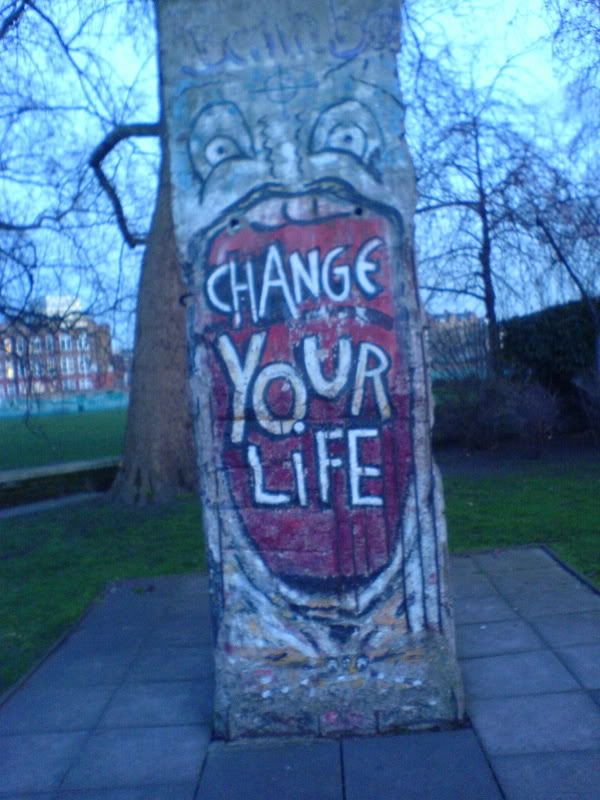
Photo Sharing and Video Hosting at Photobucket

A piece of the berlin wall that stands outside the Imperial War museum in London

Friday, 16 March 2007

Dear Anonymous

Thank you for your contributions. You are shaping the debate, I will gradually be addressing all the issues you raise.

I know there are more anonymees out there, every time you hit this blog it inspires me to do more.

As long as you keep reading, I’ll keep writing.

Kx

Stop the war?

There is a People's Assembly on Tuesday, 2:00 - 8:00pm at Central Hall Westminster in London. If you feel strongly about this, don't just say what you think in the pub go and be counted.

Stop the war

Iraq after Saddam

The Road to Kerbala is being screened at the Frontline club on Monday at 7.30pm. The film offers "insight into the heart of the long-oppressed Shia community of Iraq" as we are able to journey with them on a pilgrimage that was banned by Saddam. I'm told that it is excellent. I'll be there!

Tickets are £5 and you must register to book at Frontline club

Thursday, 15 March 2007

A love like no other

I recently e-mailed Philip Knightley, an inspiration for this blog, telling him about it and asking if he could contribute his thoughts. He kindly offered to answer some of my questions but warned me that he has spent over 30 years immersed in the topic and he is yet to be free of it.

Mr Knightley recommended that I see a review in this weeks Mail on Sunday of a book by Anthony Loyd, Another Bloody Love Letter. Knightley described Loyd as "a war junkie, hooked on war reporting who loves the risk", and critique James Delingpole appeared to agree labelling Loyd "Britain's boldest, louchest war reporter".

Delingpole speaks of Loyd as the master of an art, "He'd had this odd feeling they were about to drive into a minefield... this is the sort of life-saving intuition it takes a war correspondent years to hone". Though it almost feels as if he is describing a game when he speaks of the "powers of Loyd's sixth sense" and explains that "within every battle there is a well-kept secret: 'The shared and terrible love of it all.'"

When reading the review I am struck by Delingpole's juxtaposition of the perceived glamour of war alongside the true grit and grime somehow unseen by mavericks like Loyd, "War offers to some men a seduction that no other experience can quite match".

Tuesday, 13 March 2007

Fighting fire with fire

"Let us learn our lessons. Never, never, never believe any war will be smooth and easy, or that anyone who embarks on that strange voyage can measure the tides and hurricanes he will encounter. The statesman who yields to war fever must realise that, once the signal is given, he is no longer the master of policy but the slave of unforeseeable and uncontrollable events. Antiquated war officers, weak, incompetent or arrogant commanders, untrustworthy allies, hostile neutrals, malignant fortune, ugly surprises, awful miscalculations - all take their seat at the Council Board on the morrow of a declaration of war."

Winston Churchill, quoted in a letter to The Times

Coffee?

I read War reporting for cowards last week and literally could not put it down.

Chris Ayres had me hooked right from the very first paragraph, "Waking up, of course, shouldn't be a difficult or traumatic process. For the first twenty-seven years of my life I had done it every day without even thinking. Open eyes. Yawn. Scratch balls. Look up at the ceiling. Climb out of bed. Waking up in a Humvee on the front lines of an invasion, however, is different."

Mr Ayres' story is incredibly accessible, despite being set in a completely alien environment. His attitude is refreshingly honest. Ayres actually did my course at my University which he describes as the "Fame Acedemy" of journalism schools second only to Columbia (the X Factor? I can only assume). He describes Islington in 1997 and the lecturers. Everything that he experienced a decade ago remains almost the same today in a different form, the pub is now the Queen Boudica and the lecturers have changed but the ethos is as strong as ever. Perhaps finding these things in common made it easier for me to relate to his experience in Iraq. His words took me right there.

As soon as I finished, I sent him an e-mail. He replied the next day: "Kat - alas I live in LA, although you're welcome to meet me for a coffee here!"